The Republic of Türkiye celebrates its 100th anniversary. History of the Republic: Key points of development
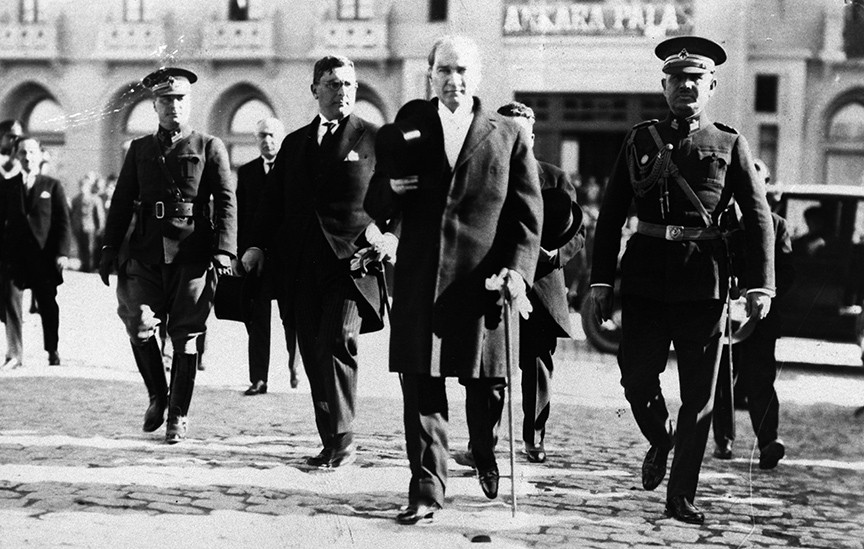
Every year on October 29, Türkiye celebrates Republic Day. In 2023, Türkiye intends to widely celebrate the centenary of the proclamation of the Republic. In this article, we will try to reflect the history of the Republic from its proclamation to the present, focusing on the main milestones of its formation and development.
The Renaissance Period
The territory of modern Türkiye consists of Anatolia and part of Thrace. The history of Anatolia encompasses the many peoples, states and civilisations that settled around Anatolia, the peninsula of Western Asia. "Minor Asia" is also called "Minor Asya".In particular, the Ottoman kingdom, which ruled from the 13th century to the 20s of the 20th century, for 600 years remained in the history of one of the largest empires in the world.
At the beginning of the 20th century, the map of the world changed dramatically. This was caused by the First World War. In particular, the state that lost its largest territories in this war became Ottoman. Ottoman territory, which emerged from the loser's war, lost its territories in the Middle East and the Balkans. In addition, Great Britain and France, as well as their allied states, introduced troops into Türkiye and occupied it. After that, the Resistance movement began, led by Mustafa Kemal Atatürk, which led the country to a war of liberation. Thus the Ottoman state became a thing of the past, and Kemal Pasha led the country into a Republic.
The first traces of civilisation in Anatolia can be found in archaeological finds in Central, Eastern and South-Eastern Anatolia. In particular, the recent discovery of the Göbeklitepe complex located within the borders of the Turkish province of Çanlıurfa has once again proved that Anatolia is an important geographical region both archaeologically and historically.
In addition, Troy, an important city for understanding the early development of European civilization, is located within the boundaries of the modern province of Çanakkale. The historical city of Troy is culturally important because of Homer's Iliad and its contribution to the fine arts.
The Roman Empire, one of the most powerful empires of antiquity, was divided into two parts, the Eastern Empire and the Western Empire in 395. The Western Roman Empire, of which Rome was the capital, disintegrated in 476. The Eastern Roman (Byzantine) Empire, founded by Constantine I in Constantinople (now Istanbul), continued to exist until 1453, when the Turks captured Istanbul.
After the Seljuk Turks from Central Asia defeated the Byzantine Empire in 1071, Turkish raids into Anatolia began. In 1077 an Anatolian Seljuk state was established in Anatolia, with its capital in Iznik (Nicaea).
As a result of the Battle of Kösedaga, which took place between the Anatolian Seljuk state and the Mongols in 1243, Anatolia came under Mongol rule and the Seljuk state weakened and gave way to the Turkish principalities. Among these principalities, the principality of Osmanogullary, based around Söğüt and Bilecik, declared its independence at the end of the 13th century.
The Ottoman Empire expanded its borders from North Africa to Central Europe during its rise after 1453. The Ottomans reached their widest borders in 1683 and entered a period of stagnation in the 19th century.
By the nineteenth century the empire had embarked on a serious process of modernisation called the Tanzimat. In 1876 the First Constitutional Monarchy began with the proclamation of a constitution and the opening of parliament and lasted until 1878, but in 1908 the Second Constitutional Monarchy was proclaimed and the constitution was again in force. However, the reforms failed to prevent the collapse of the empire.

A map of the Ottoman Empire before the First World War
Proclamation of the Republic
Beginning in 1914, the Empire entered World War I on the side of the Allied Powers but was defeated at the end of the war and on October 30, 1918 accepted the surrender of all armies, after which it was occupied by the Entente powers. On March 16, 1920, the Entente occupied Istanbul, arrested some members of parliament and sent them into exile. On 23 April 1920, the Grand National Assembly of Türkiye under the leadership of Mustafa Kemal Ataturk was established in Ankara as a result of the closure of Parliament. Under his leadership, the War of Independence (1919-1922) against the occupying forces succeeded and the Ottoman dynasty took its exclusive place in history with the abolition of the Sultanate by the Grand National Assembly of Türkiye on November 1, 1922. The Republic was proclaimed on October 29, 1923 and the new Turkish state was established. Since then, the Republic of Türkiye has continued to exist as a modern country on Anatolian soil.

Mustafa Kemal Atatürk, the founder and first president of the Republic of Türkiye, introduced a series of reforms to bring the country to the level of modern civilisation. These reforms included abolishing the Sultanate and then the Caliphate, giving women the right to vote and be elected, introducing the Latin alphabet and many other reforms. The Grand National Assembly of Türkiye gave him the surname "Atatürk" on the basis of the surname law passed in 1934.
Accession to the UN and NATO
During World War II (1939-1945), Türkiye remained neutral for a long time but in the last months of the war, on February 23, 1945, it defected to the Allied Powers. On 26 June 1945, it became a founding member of the United Nations. The difficulties encountered in crushing the communist uprising in Greece after World War II and the former Soviet Union's demand for military bases in the Turkish straits led to the proclamation of the Truman Doctrine by the United States in 1947. The doctrine provided military and economic support, seeking to ensure the security of Türkiye and Greece. Both countries were included in the Marshall Plan for the Reconstruction of the European Economy and the EEU in 1948, and then became founding members of the OECD in 1961.
Türkiye joined NATO in 1952, taking part in the Korean War (1950-1953) alongside UN forces. As a politico-military alliance, NATO is not only a fundamental element of Türkiye's security and defence policy and planning, but also embodies Türkiye's commitment to and protection of universal values such as democracy, human rights and the rule of law, and is one of the elements that constitute its 'Western identity'. Since joining the Alliance in 1952, NATO has played a central role in ensuring Türkiye's security.

Resolution on Greece and Turkiye joining the North Atlantic Treaty
Towards growth
In 2001, Recep Tayyip Erdoğan formed a new party. This party, called the Justice and Development Party, won the 2002 parliamentary election.
Abdullah Gül was elected prime minister. A year later, Recep Tayyip Erdoğan became prime minister. Türkiye did not allow the use of its territory for US ground troops during the 2003 war in Iraq.
From March 2003, a period of economic recovery began. The following year growth exceeded 9 percent and a new lira was put into circulation from 2005. During this period, Türkiye can be said to have grown significantly economically, militarily and socially, becoming one of the most influential states in the region.The country's presidential powers have been expanded since 2014, and in the same year the former prime minister
Recep Tayyip Erdoğan was elected the 12th President of the country. Two years later, after the failed military coup on July 15, 2016, the political situation in Türkiye worsened. All schools founded by Fethullah Gulen, who was considered the main culprit of the coup, were closed, the arrests of those involved in it began. The FETO organization associated with Gulen was declared a terrorist organization.
The country is currently experiencing currency depreciation caused by Turkish banking reforms. It is difficult to predict how long this process will take. The country is preparing for the next elections, which will be held in 2023. Everything will depend on these elections. To sum up, the Republic has gone through various stages and difficulties in its nearly 100-year history, which demonstrates the great experience and possibilities of rectifying the situation.
In any case, President Recep Tayyip Erdoğan, speaking in November 2022 at a meeting with the heads of the representative offices of the ruling Justice and Development Party (AKP) of Türkiye in Ankara, emphasized: "Türkiye today is one of the five G20 leaders in terms of GDP growth. This is an indicator of the strengthening of our country. I am sure that economic growth in 2022 will be a record, and the country will successfully enter 2023. "
The Turkish president called especially significant the fact that Türkiye continues economic growth amid continuing fears of a recession in the world.
Modern Türkiye and the concept of "The World is Bigger than Five"
Addressing the United Nations General Assembly (UNGA) in September 2019, Turkish President Recep Tayyip Erdoğan reiterated the thesis, which since 2013 has become his trademark: "The world is bigger than five" (Dünya Beşten Büyüktür). “The world is bigger than five” (Dünya Beşten Büyüktür), criticising the structure and system of making important decisions on world governance within the UN, where five permanent members of the UN Security Council (UNSC) have privileged status Recep Tayyip Erdoğan noted that the current world order was created after World War II to eliminate injustice. However, today the international community step by step loses the ability to develop ways to eliminate long-term threats to the future of humanity. He also explained that today's world is facing a crisis of justice: it is unacceptable that one part of the world lives in high prosperity and luxury, while another part lives in poverty and ignorance; a smaller part of humanity discusses high technology, creation of robots, artificial intelligence, obesity problem, while more than 2 billion people live below the poverty line and another 1 billion live in hunger. The future of the world should not depend on the decision of the permanent members of the UN Security Council. Justice must be achieved through fundamental reforms - change is urgently needed. Türkiye is a state whose activities are aimed at justice and fair settlement of problems in the international arena. The Turkish President enumerated problems of the modern world, showing his concern over oppression of Muslims in various regions, from Kashmir and Palestine, South Caucasus, North-Western China to the Balkans and North Africa, stressing that Ankara will not allow building a new world order at the expense of Muslims. Recep Tayyip Erdoğan also criticised the current privileged nuclear club, where members use the factor of nuclear weapons for political pressure on the one hand and prohibit the development of nuclear weapons in other countries on the other: the world must either give up nuclear weapons and destroy their stockpiles or allow others to have them, President Erdoğan concluded.

Erdoğan's book "A Fairer World Is Possible"
The Republic of Türkiye has gone through different phases in its almost century-long history, through different challenges, which demonstrates great experience and capabilities.
Modern Türkiye is one of the growing centres of geopolitical influence. The current Turkish political elite has this year, 2023, the centenary year of the establishment of the Republic of Turkey, as a milestone in its development. The ruling Turkish elite plans that the state will approach this milestone by demonstrating military, economic, technological leadership and an appealing mass culture, not only regionally but globally as well.